



Solar Energy in Pennsylvania: A Viable Option, But Not a Complete Solution
Is solar energy really a sustainable energy solution for Pennsylvania? We ask Grok – our comments are in red.
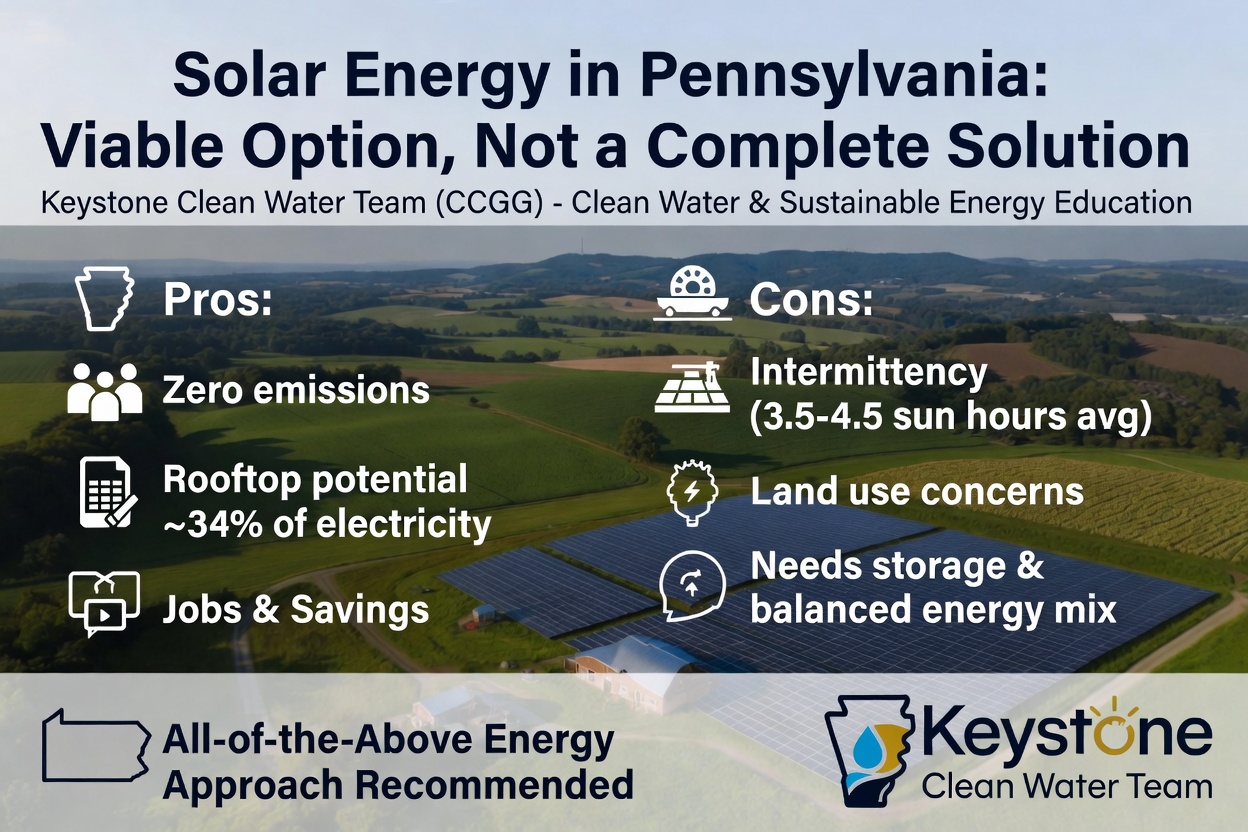
Yes, solar energy is a viable and sustainable part of Pennsylvania’s energy mix, but it’s not a complete standalone solution due to the state’s climate, grid realities, and land considerations. It offers clear environmental and economic benefits when deployed appropriately (e.g., rooftops, brownfields), complementing the state’s heavy reliance on natural gas (~58%), nuclear (~30%), and declining coal. Therefore, the answer appears to be NO, and the answer is Yes only if we use an all of the above approach to energy. (Source: https://lowcarbonpower.org/region/Pennsylvania)
Article Sponsors
The Sponsors for this Article are Jase Medical
“Emergency Medications & First Aid Kits”
Request a Free pdf copy of “Our Drinking Water“
Act Now: Subscribe to the Know Your H20 Newsletter
Resource Availability and Performance
Pennsylvania receives moderate sunlight: average peak sun hours of about 3.5–4.5 per day (roughly 4.0 statewide average for fixed panels), with ~2.8 in winter and ~4.4–5.5 in summer. (Source: https://www.integratesun.com/post/how-many-solar-sun-hours-does-your-state-really-get and https://www.turbinegenerator.org/solar/pennsylvania/ )
This is lower than the sunny Southwest (5–7+ hours) but comparable to other Northeast/Mid-Atlantic states. Solar capacity factors in PA hover around 20–25%, typical for the region. (Source: hhttps://www.epa.gov/system/files/documents/2021-09/table-4-43-solar-photovoltaic-average-capacity-factor-by-resource-class-and-vintage-i.xlsx)
- Rooftop solar has strong potential: usable rooftops could theoretically supply ~34% of the state’s electricity.
- As of recent data, installed solar capacity is ~3,086 MW (ranking ~22nd nationally), producing ~1–1.35% of electricity (plus small-scale additions), enough for hundreds of thousands of homes. (Source: https://seia.org/state-solar-policy/pennsylvania-solar )
- Growth is accelerating in some segments, with projections for several GW more in coming years, aided by federal incentives like the Investment Tax Credit.
Payback periods for residential systems are often 8–12 years (faster with high electricity rates ~13–18¢/kWh, SRECs where available, and net metering), with net savings over 20+ years. (Source: https://www.integratesun.com/post/how-many-solar-sun-hours-does-your-state-really-get and https://poweroutage.us/solar/pa)
Environmental Sustainability Pros:
- Zero operational emissions, reducing greenhouse gases, air pollution, and health impacts from fossil fuels (electricity generation is a major emissions source in PA). (Source: https://files.dep.state.pa.us/energy/Office%20of%20Energy%20and%20Technology/OETDPortalFiles/Pollution%20prevention%20and%20Energy%20assiatance/SolarFuture/Plan/PAsolarFuturePlanBookletWebfile.pdf)
- Supports grid resilience and diversification, but only if the grid is properly prepared for this irregular energy source and if there is a demand. This is one reason why storage in some form becomes critical. Without storage, the energy produces dies on the vine.
- Can use marginal lands (urbanized areas), brownfields, abandoned mine lands (>200,000 acres potential), or agrivoltaics (co-located with farming/sheep grazing or low productivity farm land).
Cons/Challenges:
- Land use for utility-scale farms raises concerns about prime farmland conversion, forest clearing, and local ecology. Projects require careful siting, decommissioning bonds, and vegetation management. (Source: https://rural.pa.gov/download.cfm?file=Resources/reports/assets/262/Impact%20of%20Solar%20Development%20on%20Pennsylvania%20Farmland%20Report%20Web.pdf)
- End-of-life recycling: Panels last 25–30+ years; infrastructure exists in PA, but scaling responsibly is needed to avoid waste issues (modules contain recoverable materials like glass, aluminum, silicon, and small amounts of hazardous elements). (Source: https://www.solarcycle.us/state-recycling/pa)
Solar’s lifecycle emissions are far lower than fossil fuels, and modern panels are increasingly recyclable, but does this include the emissions and other disturbances and environmental impacts related to mining, transport, and manufacturing? (Future Article)
Economic and Practical Factors
- Costs: Upfront investment is offset by falling panel prices, incentives, and stable “fuel” (sunlight). It can help moderate rising electricity bills amid data center demand and PJM grid pressures. (Source: https://auroraer.com/company/press-room/solar-farms-could-cut-pennsylvania-electricity-costs-by-1-billion-aurora-finds)
- Reliability: Intermittent, so it pairs best with storage, demand response, nuclear baseload, natural gas baseload, or hydro/wind. Winters and clouds reduce output, but the grid handles this via diversity.
- Policy: PA lags neighbors in renewables share (~4–5% total renewables) and growth rankings, with a modest AEPS standard. Fossil subsidies and local zoning vary; some areas restrict farms. (Source: https://www.spotlightpa.org/news/2025/09/renewable-energy-philadelphia-cost-pennsylvania-environment/ and https://environmentamerica.org/pennsylvania/media-center/new-data-pa-ranks-abysmal-47th-in-u-s-for-renewable-energy-growth/ )
Ambitious targets (e.g., 10% solar) exist in plans but face political and interconnection hurdles.
Overall Assessment
Solar is sustainable in Pennsylvania for:
- Distributed/rooftop applications (homes, schools, businesses) — high value, minimal land impact.
- Targeted utility-scale on non-prime lands or brownfields- Not Viable Farm Land or Forest Lands !
It won’t replace dispatchable sources entirely due to weather and scale, but it meaningfully cuts emissions, creates jobs, boosts energy security, and saves consumers money long-term. PA’s “Solar Future” analyses project net benefits from expanded deployment. (Source: https://files.dep.state.pa.us/energy/Office%20of%20Energy%20and%20Technology/OETDPortalFiles/Pollution%20prevention%20and%20Energy%20assiatance/SolarFuture/Plan/PAsolarFuturePlanBookletWebfile.pdf )
Challenges like land use, policy inertia, and intermittency are real but addressable with better planning, storage, and incentives. A balanced portfolio (solar + nuclear + gas + efficiency+ hydro etc- i.e., an all the above approach) is the pragmatic path for reliable, lower-carbon energy in the state. If you’re considering installing solar, check local incentives, roof suitability, and payback via tools like Google Project Sunroof.